
Lot 100 – Pierre-François Jumeau Fashion Poupee, Late 1860s
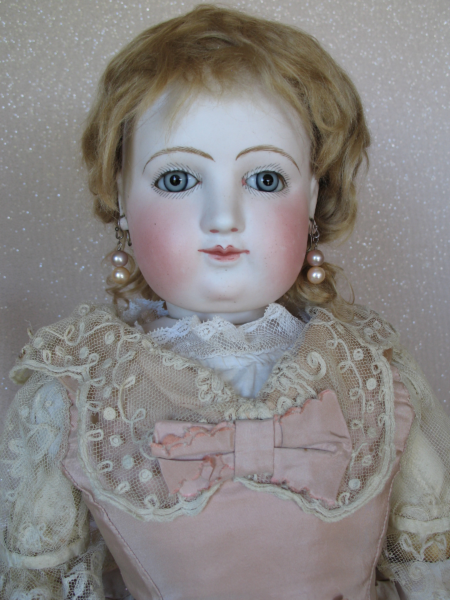
A Fine Example of Early Parisian Fashion Doll Artistry
This elegant Pierre-François Jumeau Fashion Poupee, dating to the late 1860s, represents the height of Parisian taste and craftsmanship during the golden age of the French fashion doll. Created prior to the introduction of the Jumeau Bébé, fashion poupees such as this were designed not as children’s playthings but as sophisticated adult figures intended to display the latest couture styles of the Second Empire period.
Standing an impressive 25 inches (63cm), this poupee embodies refinement, luxury, and historical importance, making it a highly desirable acquisition for collectors of early French dolls and 19th-century decorative arts.
Historical Context and Importance
During the mid-19th century, Paris was the undisputed capital of fashion, and French fashion dolls played a vital role in disseminating style across Europe and beyond. Pierre-François Jumeau was among the most respected manufacturers of these dolls, producing figures renowned for their fine bisque, lifelike expressions, and superior materials.
Fashion poupees from this era predate mass production and were crafted with extraordinary attention to detail. They were often dressed in elaborate ensembles that mirrored contemporary couture, serving as both fashion ambassadors and luxury objects. Today, surviving examples in attractive condition are increasingly scarce, particularly those retaining original components and harmonious presentation.
Bisque Head and Modelling
This doll features an extremely fine pale pressed bisque head set upon a bisque shoulderplate, a characteristic construction of high-quality fashion poupees from this period. The head is unmarked, as expected for many dolls of the 1860s, where attribution is determined by quality, modelling, and stylistic traits rather than factory stamps.
The modelling is delicate and balanced, with smooth transitions and refined contours. The bisque retains a soft, luminous tone that enhances the doll’s aristocratic appearance and speaks to the quality of the firing and materials used.
Eyes, Brows, and Facial Painting
The poupee is fitted with striking grey almond-shaped paperweight eyes, distinguished by darker outer irises that lend depth and realism. Fine angled lashes frame the eyes, complemented by a precisely applied black upper eyeliner that enhances definition without heaviness.
Particularly notable are the beautifully executed brows, long and arched, with almost striated brushstrokes that reflect the finest hand-painting techniques of the era. These brows give the doll a composed, intelligent expression, typical of high-end fashion poupees.
The closed pink mouth is exquisitely painted, with darker peak accents and a finely shaped inner upper lip line. Soft blush to the cheeks adds warmth and vitality while maintaining elegance. The overall facial painting is subtle and harmonious, allowing the quality of the bisque modelling to shine.
Ears, Wig, and Pate
The doll has pierced ears, fitted with appropriate drop earrings that enhance her fashionable presentation. She retains a blonde mohair wig, styled in a manner consistent with late 1860s fashion, set upon an original cork pate.
The neck is secured by a wood button neck attachment, a construction detail commonly seen on early fashion poupees and valued by collectors for its authenticity. The survival of these original elements adds significantly to the historical integrity of the doll.
Body Construction and Materials
The doll stands on a kid leather gusset-jointed body with a straight collarette, a luxurious and highly desirable body type associated with upper-quality fashion dolls. The kid leather retains good structure, with individual toes and refined shaping that reflect the skilled workmanship of the period.
The bisque forearms are finely modelled, with blushed hands and delicately painted pink nails, demonstrating the attention to realism that distinguishes French fashion dolls from their contemporaries. There are some period kid patch repairs to the legs, consistent with age and careful historical maintenance, and typical for dolls of this construction.
Costume and Accessories
The poupee is beautifully dressed in a musk taffeta walking-out ensemble, trimmed with fine French lace, evoking the elegance of late Second Empire fashion. The choice of fabric and cut complements the doll’s stature and enhances her presence as a fashion figure rather than a child doll.
She is accompanied by vintage undergarments, pink socks, and a pair of antique white kid leather lace-up shoes, complete with leather rosettes. These shoes are particularly attractive and contribute significantly to the completeness of the presentation.
The overall costume arrangement is tasteful and well balanced, allowing the doll to be displayed as a cohesive and visually striking example of a 19th-century fashion poupee.
Condition Overview
Considering her age, this Pierre-François Jumeau fashion poupee presents very well. The bisque head and shoulderplate display excellent colour and surface quality, with finely preserved facial painting. The kid leather body shows expected signs of age, including historical repairs, but remains stable and appropriate.
Costume elements are well chosen and consistent with the period, enhancing the doll’s appeal without detracting from her authenticity. As always, condition should be assessed in conjunction with images and viewing where possible.
Collector Appeal and Display Value
Fashion poupees of this quality and scale are increasingly difficult to acquire, particularly examples that retain original structural components, expressive facial painting, and elegant period dress. This doll’s strong visual presence, refined modelling, and historical significance make her suitable for inclusion in a museum-quality collection or as a centrepiece in an advanced private collection.
She will appeal to collectors of early Jumeau dolls, fashion history enthusiasts, and those seeking an object that embodies the artistry and luxury of 19th-century Paris.
Conclusion
This late 1860s Pierre-François Jumeau Fashion Poupee is a superb example of early French doll artistry, combining elegant bisque modelling, refined facial painting, luxurious materials, and sympathetic presentation. As a representation of Parisian fashion and craftsmanship at its height, she stands as both a historical artefact and a work of decorative art.
A rare and distinguished offering, presented with confidence by Abbingdon Auctions Australia.
Back to Blog