
Lot 98 – Emile Jumeau “Première Bébé”, 1878
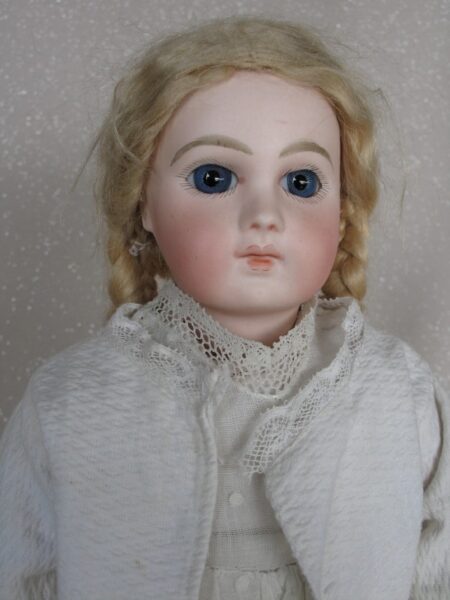
Lot 98 – Emile Jumeau “Première Bébé”, 1878
An Important First-Period French Bisque Bébé
This outstanding Emile Jumeau “Première Bébé”, dating to 1878, represents one of the earliest and most revered expressions of the Jumeau aesthetic. Dolls from this first period are widely regarded as the foundation upon which the later success and international reputation of the Jumeau firm was built. Highly sought after by discerning collectors, early Première Bébés are distinguished by their refined modelling, subtle facial expression, and exceptional quality of manufacture.
Measuring 14 inches (36cm), this example is a particularly appealing cabinet-size doll, offering both rarity and charm in a manageable and display-friendly format.
Historical Context and Significance
The Première Bébé was introduced by Emile Jumeau during the late 1870s, marking a decisive moment in French doll-making history. At a time when competition among Parisian manufacturers was fierce, Jumeau’s early Bébé designs set new standards for realism, expression, and artistic finesse. These first-period dolls predate the more widely produced later Jumeau Bébé lines and are therefore considerably scarcer.
Collectors prize these early examples for their soft, childlike expressions, often described as shy or introspective, which contrast beautifully with the more assertive expressions seen in later models. This doll exemplifies those early artistic ideals and stands as a fine representation of Jumeau’s formative years.
Head and Facial Modelling
The finely modelled pale pressed bisque head, incised “5”, displays exceptional quality and balance. The doll features a closed rose-pink mouth with carefully applied peak lip accents and gentle inner shading, creating a naturalistic and refined appearance. The modelling of the white space around the lips is subtle and well executed, a hallmark of early Jumeau craftsmanship.
The facial painting is of high standard, with delicately accented nostrils and eye corners, enhancing depth and realism. A soft, even blush warms the cheeks without overpowering the expression, contributing to the doll’s serene and slightly shy countenance.
Eyes, Brows, and Expression
The doll is fitted with beautiful blue glass inset paperweight eyes, framed by angled upper and lower lashes that add definition while maintaining softness. Painted eyeliner is finely applied, accompanied by gentle rose-toned eye shadow, lending further depth to the gaze.
The brows are superbly executed, with fine feathering and natural arching that enhance the contemplative expression. Together, these features give the doll a distinctive personality—one that immediately appeals to collectors familiar with the subtleties of early French bisque dolls.
Ears, Wig, and Pate
The head is completed with pierced ears, an attractive and desirable feature consistent with dolls of this quality and period. The doll wears a blonde mohair wig, styled in plaits, set over a cork pate. The wig complements the gentle colouring of the bisque and enhances the overall harmony of the presentation.
The survival of an appropriate period wig and pate adds to the doll’s desirability, as original or early wigs are increasingly difficult to find in such pleasing condition.
Body and Markings
The doll is presented on an original French straight-wrist composition ball-jointed body, stamped “Jumeau Médaille d’Or Paris”. This prestigious body stamp reflects the international recognition awarded to the Jumeau firm during this period and is a key identifying feature for collectors.
There are some old retouches to the body, consistent with age and careful historical preservation. These do not detract from the overall integrity of the doll and are typical of antique dolls that have been cherished and maintained over generations.
Costume and Presentation
The Première Bébé is attractively dressed in an antique white pique hailspot ensemble, a style entirely appropriate to the period. The costume includes a matching jacket trimmed with lace, along with antique undergarments, socks, and vintage red leather shoes that provide a pleasing contrast to the pale costume.
The ensemble enhances the doll’s presence without overwhelming it, allowing the quality of the bisque head and expression to remain the focal point. Such thoughtfully curated presentation is in keeping with the standards expected by collectors and clients of Abbingdon Auctions Australia.
Condition Overview
Overall, this doll presents extremely well for its age. The bisque head retains excellent colour and modelling, with finely preserved painting and no distracting issues visible in display. The body shows expected age-related wear, including old retouches, but remains sound and appropriate. Costume elements are antique and well chosen, contributing positively to the doll’s overall appeal.
As with all items offered by Abbingdon Auctions Australia, condition should be assessed in conjunction with photographs and viewing where possible.
Collector Appeal and Rarity
Early Première Bébé Jumeau dolls are increasingly difficult to source, particularly examples that retain strong facial painting, original stamped bodies, and sympathetic period dress. This doll’s first-period date, charming expression, and high-quality presentation place it firmly within the upper tier of collector interest.
It will appeal not only to dedicated Jumeau collectors but also to those seeking a representative example of early French bisque artistry. Its manageable size makes it suitable for both cabinet display and inclusion in a broader museum-quality collection.
Conclusion
This 1878 Emile Jumeau Première Bébé is a refined and historically important example of early French doll-making. With its soft, shy expression, excellent bisque modelling, original stamped body, and attractive antique costume, it embodies the qualities that have made Jumeau dolls enduring icons of the collecting world.
A rare opportunity to acquire a first-period Jumeau of genuine charm and presence, offered with confidence by Abbingdon Auctions Australia.
Back to Blog